






First, Why Do You Need Encryption at All?
Unsecured radio waves can expose your business to significant risks.
Protecting Sensitive Business Strategies: Competitors could listen in on logistical plans, pricing discussions, or operational details.
Ensuring Guest and Client Privacy: Hospitality and security teams often discuss guest information or sensitive incidents. Protecting this privacy is crucial for your reputation.
Securing Loss Prevention Operations: Retail security teams coordinating to monitor a shoplifter cannot risk their plans being overheard.
The Levels of Security: Scrambler vs. Encryption
"Encrypted" is a broad term. Understanding the different levels is key to choosing the right tool. The scrambler vs encryption debate is the most important distinction to grasp.
Level 1: Voice Scrambling (Basic Privacy)
Scrambling is a basic form of voice inversion. It mixes up the audio frequencies to make the conversation sound garbled to a casual listener with a standard scanner.
Pros: Inexpensive, better than nothing.
Cons: Can be easily defeated with simple descrambling software.
Best for: Deterring casual eavesdropping in low-risk environments.
Level 2: Basic Digital Encryption (Strong Security)
True dmr encryption is a feature of Digital (DMR) radios. It converts your voice into digital data and then uses a secret key (e.g., 40 to 128-bit) to encrypt it. Without the key, the signal is just meaningless digital noise.
Pros: Very strong security against all but the most sophisticated adversaries.
Cons: Requires digital radios.
Best for: The professional standard for most security, business, and industrial use.
Level 3: AES256 Encryption (Maximum Security)
This is the gold standard of data security, used by governments and military agencies. An aes256 radio uses a 256-bit key, which is considered virtually unbreakable by any known computer.
Pros: The highest level of communication security commercially available.
Cons: Found only on high-end professional radios.
Best for: Mission-critical operations involving public safety, financial data, or national security.
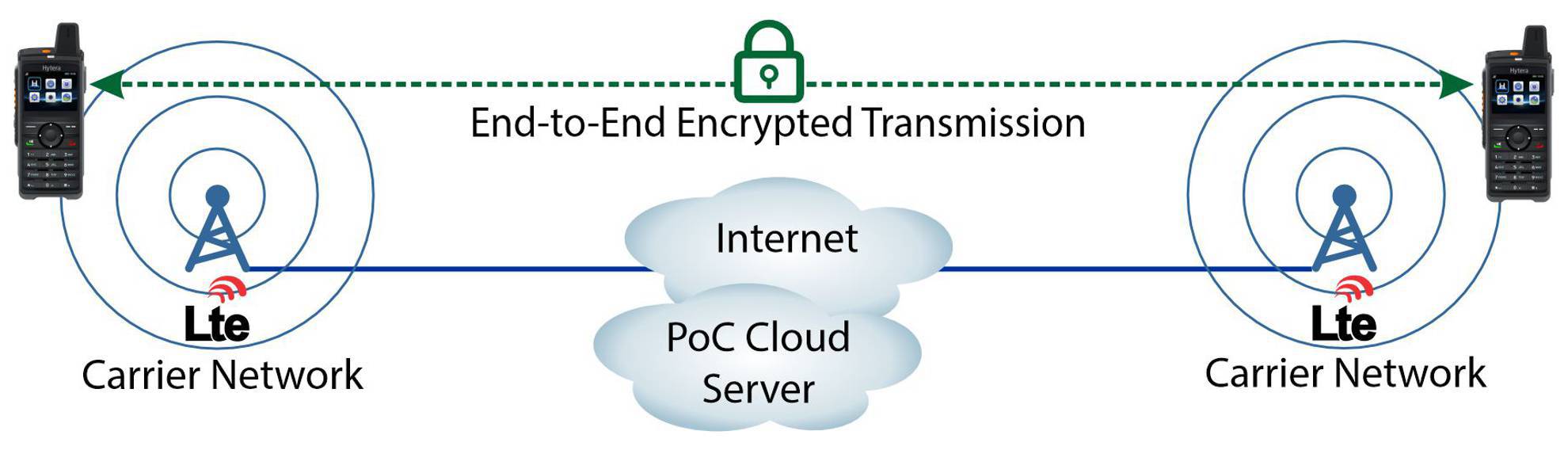
Matching the Lock to the Risk: Which Level Do You Need?
Your security needs should dictate your choice.
For Hospitality & Retail: A private walkie talkie with basic voice scrambling is often a great, cost-effective start to prevent customers or opportunistic listeners from hearing operational chatter.
For Most Businesses & Security: DMR dmr encryption is the professional sweet spot. It provides robust protection that is more than enough to secure the daily operations of most security firms, construction sites, and large businesses.
For High-Stakes Ops (Finance, Government): When the information being discussed is mission-critical and cannot be compromised under any circumstances, an aes256 radio is the only responsible choice.
Finding Your Secure Solution with Chierda
As a leading , we offer a full spectrum of secure solutions to match your needs and budget.
Basic Privacy: Our compact models like the CD350 and CD360 feature built-in voice scrambling for essential privacy.
Professional Security: Our extensive line of DMR radios offers strong digital encryption as a standard or optional feature.
Maximum Security: Our high-end, , such as the TC338D and TC56D, provide government-grade protection for your most sensitive communications.
Your Conversation is an Asset. Protect It Accordingly.
In business and security, information is power. Leaving your communications unprotected is a risk you don't need to take. By choosing an encrypted walkie talkie that matches your operational risk level, you are making a smart investment in your organization's security and integrity.
FAQ: Your Encrypted Radio Questions Answered
Does using encryption reduce my radio's range or battery life?
On modern digital radios, the impact is negligible. The encryption process is handled by a dedicated processor and is extremely efficient. You will not notice a meaningful difference in performance or battery life.
Can an encrypted radio talk to a non-encrypted radio?
No. For an encrypted conversation to work, all radios in the group must be programmed with the same encryption key and algorithm. However, most encrypted radios can be switched to a clear, non-encrypted channel to talk with basic radios.
Are there any legal restrictions on using encrypted radios?
In the vast majority of commercial and personal use cases in countries like the US, there are no restrictions. However, it's always good practice to comply with your local telecommunications laws.
How do I manage encryption keys for my team?
Encryption keys are programmed into the radios using the manufacturer's programming software. This ensures that only your authorized radios can communicate securely. If you need help, feel free to