






beyond "unlimited range," what does it really take to deploy a successful Push-to-Talk over Cellular (PoC) system? This technology is more than just a new type of hardware; it's a complete ecosystem. This poc radio guide will give you the deep dive you need to understand the hardware, the costs, and the powerful software that makes it all work.
The PoC Ecosystem: The 3 Pillars of Nationwide Communication
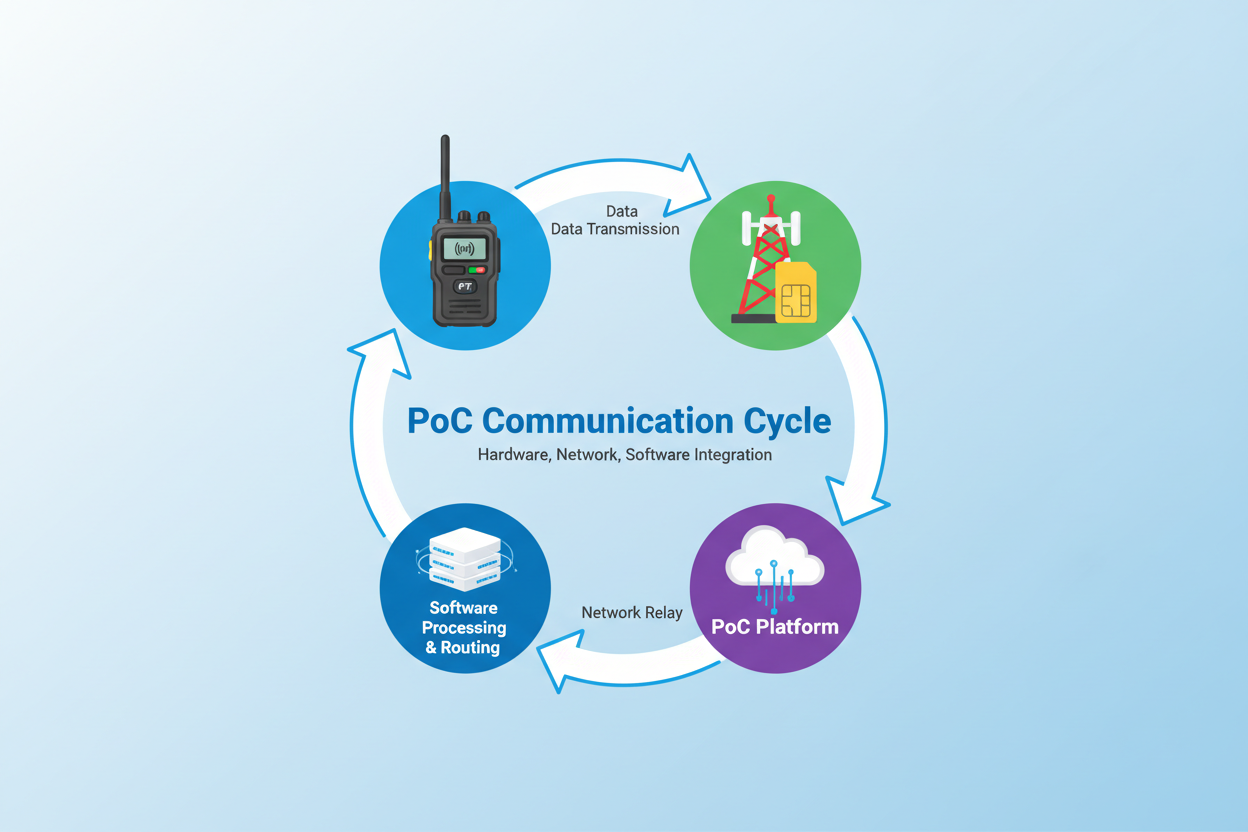
To understand push-to-talk over cellular, you need to understand its three essential components. A failure in any one of these pillars means the system won't work.
1. The Hardware: Your Rugged, Purpose-Built Device
This is the physical radio you hold in your hand. Unlike a fragile smartphone, a professional PoC radio is built for durability, with loud speakers, long-lasting batteries, and a dedicated PTT button. It's the rugged foundation of your system.
2. The Network: Choosing a SIM Card and Data Plan
The PoC radio connects to the internet using a cellular network, just like your phone. This means each radio requires its own SIM card and a data plan from a mobile carrier (like AT&T, T-Mobile, Verizon, etc.).
3. The Software: The "Brain" of the Operation (The PoC Platform)
This is the most critical and often misunderstood part. When you press the PTT button, your voice is sent to a server run by a PoC platform provider. This platform's software then instantly routes your voice to the correct group. The platform is what provides the user interface, dispatch features, and GPS tracking.
Understanding the True PoC Radio Cost (Total Cost of Ownership)
A common question is about the poc radio cost. It's more than just the price of the handset. To budget properly, you need to consider the Total Cost of Ownership (TCO).
Initial Cost: The Price of the Handset: This is your one-time hardware purchase.
Recurring Costs: The Data Plan: A monthly fee paid to your cellular carrier for each SIM card. (Note: Voice over PoC uses very little data).
Recurring Costs: The Platform Subscription Fee: A monthly or annual fee paid to the PoC platform provider for each radio on your account. This fee covers the server access and use of their software.
While there are recurring costs, they are often significantly lower than the cost of building and maintaining a private, wide-area traditional radio network with repeaters.
Choosing Your PoC Platform: What Are Your Options?
The hardware is only as good as the software it runs on. Choosing the right PoC Platform is crucial.
Public Platforms like Zello: Pros and Cons
Platforms like Zello offer a free or low-cost entry point. They are great for small teams or personal use but may lack the advanced features, dedicated support, and guaranteed reliability (SLA) that professional organizations require.
Professional Platforms: Advanced Features and Support
Professional platforms (like Real-PTT, POCSTARS, etc.) are built for business. They offer robust gps dispatch software, dedicated technical support, and higher reliability, making them the standard choice for mission-critical operations.
Key Factors: Dispatch Software, GPS Features, and Reliability
When choosing, ask yourself: Do I need a PC-based dispatcher? Is historical GPS tracking important? Do I need an uptime guarantee? Your answers will guide you to the right platform.
The Killer App: GPS Dispatch Software and Fleet Management
For most businesses, the true power of PoC lies in its gps dispatch software. This transforms the system from a simple communication tool into a comprehensive fleet management solution.
See Your Entire Fleet on One Screen with Live Tracking
A dispatcher can view the real-time location of every employee and vehicle on a single map, allowing for smarter assignments and faster response times.
Improve Accountability with Historical Route Playback
Need to verify a delivery or review a driver's route? Most platforms allow you to play back the location history for any device over a specific time period.
Automate Alerts with Geofencing
You can create virtual boundaries (geofences) on the map. The system can then automatically send an alert when a vehicle enters or leaves a designated area, like a job site or a restricted zone.
Chierda's Hardware: The Reliable Foundation for Your PoC System
At Chierda, we focus on building the most reliable hardware to serve as the foundation of your PoC system.
Full Compatibility with Leading PoC Platforms: Our devices are tested and proven to work seamlessly with the most popular professional PoC platforms on the market.
A Range of Devices: We offer a full , from ultra-compact models like the NBM1 for hospitality to full-featured, Android-based devices like the P6 for logistics.
Built for Durability and Long Battery Life: As a for over 30 years, we know how to build hardware that survives the real world.
Make the Smart Choice: The Right Hardware for the Right Platform
Deploying a push-to-talk over cellular system is a powerful move for any modern, mobile business. Success lies in understanding that you're choosing a complete system, not just a device. By selecting reliable hardware that is perfectly matched to a professional software platform, you can unlock a new level of efficiency and control.
FAQ: Technical Questions About PoC Technology
How much data does a PoC radio use per month?
Voice over PoC is very efficient. Even for a heavy user, monthly data consumption is typically very low, often under 500MB. A basic, inexpensive data plan is usually more than sufficient.
Is there a noticeable delay (latency) when speaking on a PoC radio?
There is a slight delay (latency) as your voice travels over the cellular network to the server and back. However, on modern 4G/LTE networks, this delay is typically less than half a second and is not an issue for most professional applications.
Can PoC radios be integrated with our existing DMR/Analog radio system?
Yes, this is a major advantage. Using a "gateway" device, you can bridge your PoC system with your on-site DMR or analog radio network. This creates a unified system where your nationwide drivers can talk directly to your local warehouse staff.
What happens if the PoC platform's server goes down?
This is why choosing a professional platform with a reliability guarantee (Service Level Agreement or SLA) is important. Reputable platforms have redundant servers and backup systems to ensure downtime is extremely rare. If you have any more questions, feel free to .