






Why are people talking over each other? Providing the equipment is only the first step. If your team does not understand standardized walkie talkie lingo and basic radio manners, your communication network will fail.
Stop the confusion. Standardized terminology eliminates guesswork, drastically reduces errors, and turns a noisy channel into a streamlined operational tool. This guide will teach your team how to master professional radio communication.
The Golden Rules of Professional Radio Etiquette
Before learning the specific vocabulary, every user must understand the fundamental rules of operation. Good radio etiquette prevents dead air and broken messages.
Rule 1: Listen Before You Transmit (Avoid "Stepping" on Others)
Never just press the button and talk. Always listen to the channel for at least two seconds. If someone else is speaking, wait until they finish. Pressing your button while someone else transmits causes "stepping," which blocks both messages and creates an annoying squeal on the channel.
Rule 2: Think, Press, Pause, Speak (The 1-Second Delay)
Know exactly what you want to say before you touch the radio. Once you are ready, press the Push-To-Talk (PTT) button firmly. Pause for one full second, and then begin speaking. Radios need a fraction of a second to open the connection. If you speak immediately, the first word of your sentence gets cut off.
Rule 3: The K.I.S.S. Principle (Keep It Short and Simple)
Two-way radios are not telephones. They are meant for quick, tactical updates. Apply the K.I.S.S. principle: Keep It Short and Simple. State your business clearly, wait for confirmation, and free up the channel for other users.
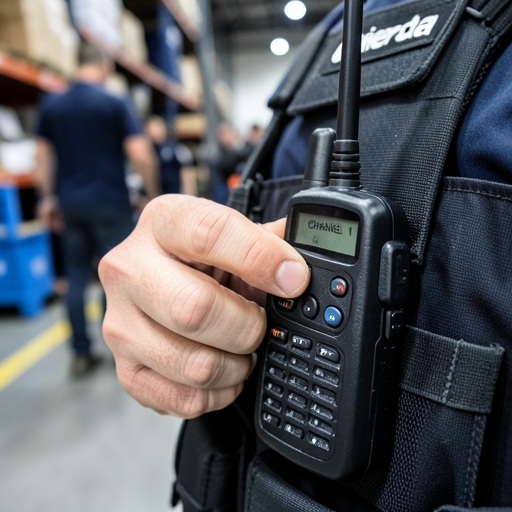
Essential Walkie Talkie Lingo: Words You Need to Know
Hollywood movies often misrepresent how real professionals talk on a radio. Learning the correct walkie talkie lingo prevents dangerous misunderstandings.
"Roger" vs. "Copy" vs. "Wilco": Acing Confirmation
Roger: This means "I have received your transmission." It does not mean you agree with it, only that you heard it.
Copy: Similar to Roger, meaning "I understand your message."
Wilco: This stands for "Will Comply." It means you received the message, understood the instructions, and will perform the requested action.
"Over" vs. "Out": Managing the Flow of Conversation
Over: This means "I have finished speaking, and I am waiting for your reply." It signals the other person that it is their turn to talk.
Out: This means "The conversation is finished, and I expect no reply." It releases the channel for others to use.
Why You Should Never Say "Over and Out" (The Hollywood Myth)
You hear "Over and out" in movies, but it makes no sense in real professional radio communication. "Over" means you want a reply. "Out" means you do not want a reply. You cannot do both simultaneously. Use one or the other.
Using "Standby" and "Radio Check" Correctly
Standby: Use this when you acknowledge a call but need a few moments to gather information before replying.
Radio Check: Use this phrase to test your signal strength. A proper response is "Reading you loud and clear" (meaning excellent signal) or "Reading you weak and unreadable" (meaning poor signal).
The NATO Phonetic Alphabet: Spelling it Out for Clarity
Why does "B" sound like "D" over the airwaves? Background noise and radio static easily distort similar-sounding letters. When transmitting critical information like license plate numbers, passenger names, or security codes, you must use the NATO phonetic alphabet.
This internationally recognized system assigns a specific word to every letter of the alphabet.
A - Alpha | B - Bravo | C - Charlie | D - Delta | E - Echo
F - Foxtrot | G - Golf | H - Hotel | I - India | J - Juliet
K - Kilo | L - Lima | M - Mike | N - November | O - Oscar
P - Papa | Q - Quebec | R - Romeo | S - Sierra | T - Tango
U - Uniform | V - Victor | W - Whiskey | X - X-ray | Y - Yankee | Z - Zulu
For example, spelling the code "B-D-T" becomes "Bravo-Delta-Tango." This guarantees 100% accuracy.
A Quick Guide to 10 Codes (Ten-Codes) for Business Users
Police officers originally developed 10 codes to shorten common phrases and speed up dispatch times. Many logistics and security teams still use them today.
The Classics: 10-4, 10-20, and 10-9
10-4: Message received and understood (affirmative).
10-9: Please repeat your last transmission.
10-20: What is your location? (e.g., "What is your 10-20?")
The Modern Debate: Plain English vs. 10-Codes in Business Security
While 10 codes sound professional, many modern agencies now prefer "Plain English." Using plain language reduces training time for new hires and eliminates confusion during high-stress emergencies. Unless your company has a strict code manual, speaking clearly and simply is always the safest bet.
Clear Audio + Clear Rules = Unstoppable Team Efficiency
Equipping your staff with knowledge is just as important as equipping them with hardware. When your team masters these communication standards, operations run smoother, safety incidents decrease, and overall efficiency skyrockets.
FAQ: Training Your Team on Professional Radio Communication
Do we have to use the NATO phonetic alphabet in a retail store? While not mandatory, it is highly recommended. If a retail employee needs to verify a specific product SKU or a customer's last name for a pickup order, using the phonetic alphabet prevents frustrating errors over the radio.
How can I train new employees on walkie talkie etiquette quickly? How to train staff on radio rules? Print out a small, laminated card with your company's core radio rules and the phonetic alphabet. Attach this card to the back of their ID badge or lanyard so they can reference it instantly during their first few weeks.
What should I do if someone is constantly interrupting on the radio channel? Managers should intervene immediately. Use the radio to politely remind the team to listen before transmitting. If the problem persists, conduct a brief refresher training session on proper radio discipline for the entire staff.
Can a good headset or earpiece make radio lingo easier to understand? Absolutely. Background noise drowns out clear speech. Providing your staff with a noise-isolating ensures they hear every "Roger" and "10-4" clearly. Partnering with a trusted