






You know that Digital Mobile Radio (DMR) offers clearer audio and better performance than analog, but the world of DMR is filled with new terms: Tier I, Tier II, Tier III, TDMA. It can seem confusing. This dmr radio guide is here to simplify it all, helping you understand the landscape and choose the perfect digital radio for your business.
A Quick Refresher: The Core Benefits of DMR
Before diving into the tiers, let's quickly recap the fundamental benefits of dmr. As we covered in , compared to analog, DMR radios offer:
Superior Audio Clarity: Digital processing eliminates static and background noise.
Longer Battery Life: Up to 40% more efficient, thanks to TDMA technology.
Enhanced Security and Privacy: Digital encryption keeps your conversations private.
Data Capabilities: Enables advanced features like GPS tracking and text messaging.
Understanding the DMR Tiers: A Simple Breakdown
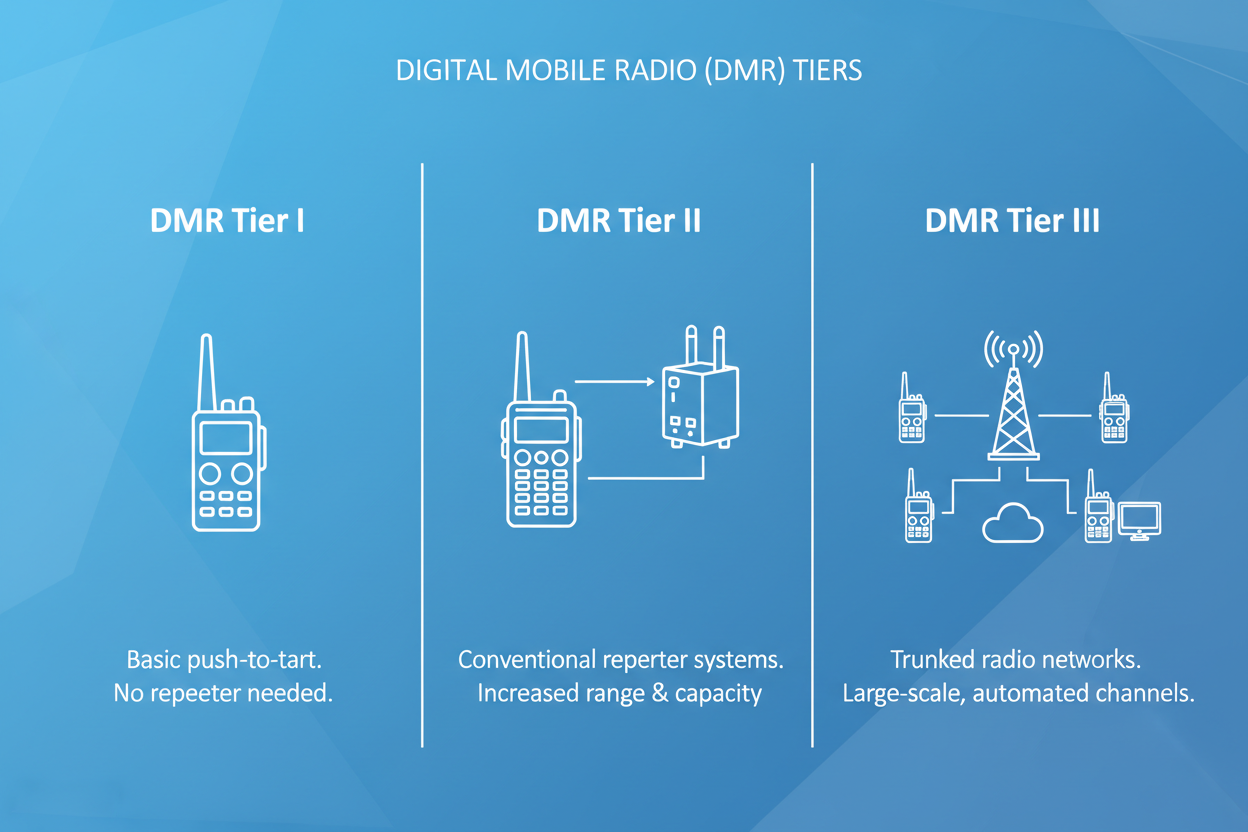
What is dmr radio's structure? The DMR standard is organized into three "Tiers," each designed for a different type of user.
Tier I: License-Free, Low-Power Digital
This is the simplest form of DMR. It's for license-free use (similar to PMR446 in Europe) on public frequencies. The power is limited, and repeaters are not allowed. It's great for personal use or very small businesses operating over short distances.
Tier II (Conventional): The Professional Standard for Business
This is the most common and important tier for professional users. DMR Tier 2 radios require a license to operate on specific business frequencies. Crucially, they can work directly radio-to-radio or through a repeater to greatly extend range. This is the standard for most businesses, from construction sites to hotels and security teams.
Tier III (Trunked): For Large-Scale Operations
DMR Tier III is for large organizations with a high number of users in a limited area, like a university campus, airport, or large factory. It uses a technology called dmr trunking, where a central controller automatically assigns frequencies to users as they need them. It's a highly efficient—but also more complex and expensive—solution.
The Sweet Spot: Why DMR Tier 2 is Perfect for Most Businesses
For over 90% of business users, DMR Tier 2 is the perfect choice. Its power lies in a single, game-changing technology.
The Magic of Two-Slot TDMA (Dual Slot DMR)
TDMA stands for Time-Division Multiple Access. It cleverly splits a single frequency into two virtual "time slots." This means you can have two completely separate conversations on the same frequency at the same time.
How a dual slot dmr Doubles Your Capacity
Imagine you have one frequency license. With analog, only one team can talk at a time. With a dual slot dmr system, your security team can use Slot 1 while your maintenance team uses Slot 2, all on the same single frequency. You get double the communication capacity without paying for a second license.
Seamless Integration with Repeaters to Boost Your Range
Tier II radios are designed to work with repeaters, allowing you to build a communication network that can cover a massive industrial site, a multi-story building, or a sprawling farm.
Your DMR Radio Shopping Checklist: Must-Have Features
When browsing this dmr radio guide for your business, consider these key features:
Level of Encryption Needed: Do you need basic digital privacy, or do your operations require the military-grade protection of AES256?
GPS Tracking: Is tracking your fleet or personnel important for efficiency and safety?
IP Rating for Waterproofing and Durability: Match the radio's ruggedness to your work environment.
Full Keypad vs. No Keypad Models: Do your users need to send text messages and make individual calls (keypad), or do they just need simple PTT and channel selection (no keypad)?
Invest in a Digital Future That Fits Your Business
Choosing to go digital with DMR is a smart move. The next step is to choose the right type of DMR. For most businesses, a Tier II system offers the perfect balance of power, efficiency, and advanced features. It’s a scalable platform that can grow with you.
FAQ: Your Top DMR Questions Answered
Are all DMR radios compatible with each other (e.g., Chierda and Motorola)?
Yes, as long as they adhere to the same DMR Tier. For example, any Tier II compliant radio can talk to any other Tier II compliant radio, regardless of the brand. This interoperability is a key benefit of the DMR standard.
What is the process for migrating from an analog system to a DMR system?
Is DMR trunking (Tier III) very expensive?
Yes, Tier III systems require significant investment in infrastructure, including a central controller and multiple repeaters. It is a powerful solution, but only necessary for very large organizations. For everyone else, Tier II is far more cost-effective.
Do I need a different license for a DMR radio?
You will need a business radio license to operate on professional frequencies, but generally, the same license covers both analog and digital (DMR) operation on those frequencies. If you have questions about your specific needs, it's always best to